Why Is PEEK Rod Preferred Over Nylon, PTFE, and Delrin for Industrial Applications?

Polymat India
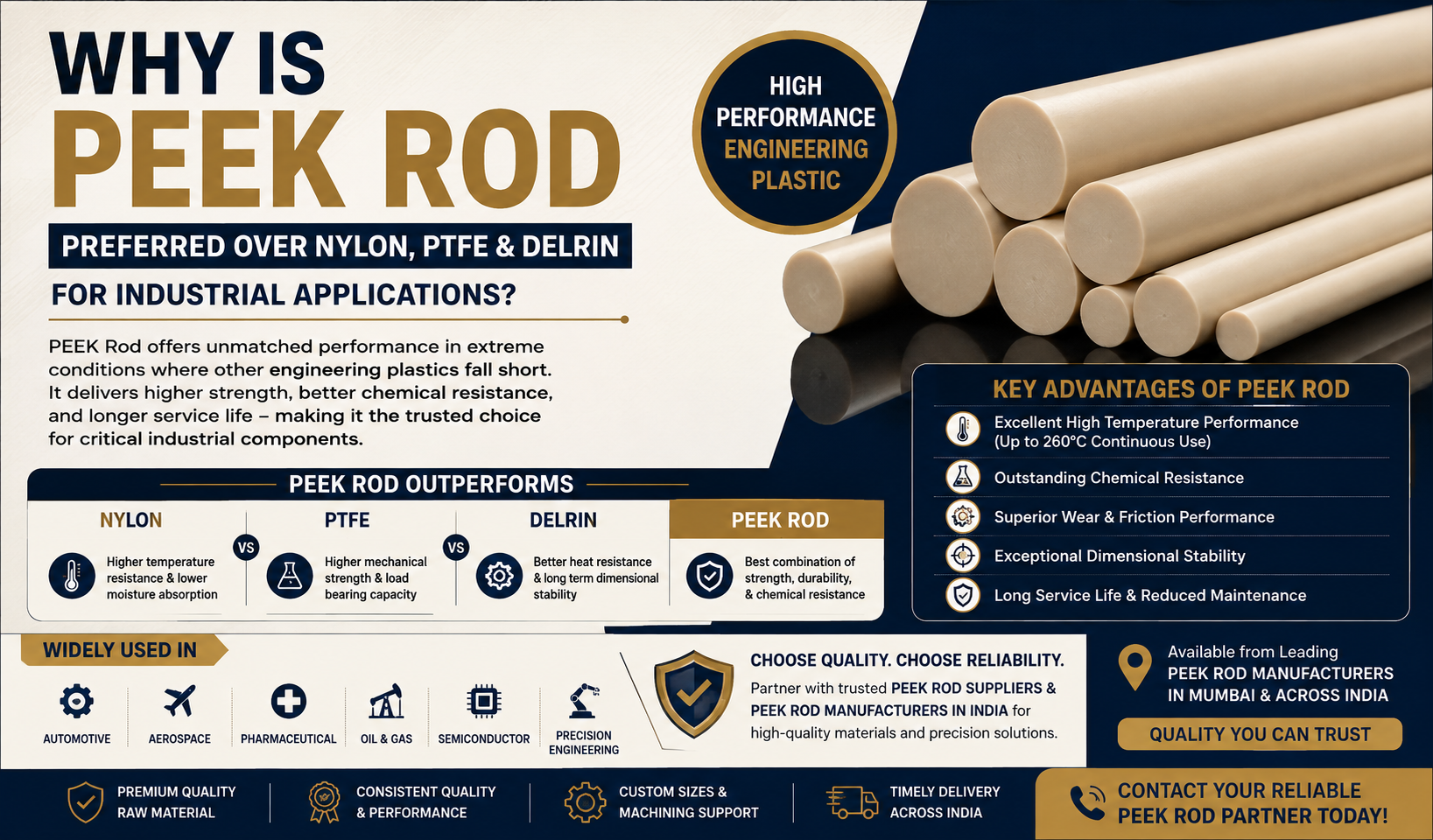
PEEK rod is preferred over Nylon, PTFE, and Delrin because it offers exceptional heat resistance, superior mechanical strength, excellent chemical resistance, outstanding wear performance, and remarkable dimensional stability. These properties make PEEK the ideal engineering plastic for demanding industrial applications where reliability and long service life are essential.
Introduction
Choosing the right engineering plastic is one of the most important decisions in industrial manufacturing. The material used in gears, bearings, bushings, valve seats, electrical insulators, and precision machined parts directly affects equipment performance, maintenance costs, and product lifespan.
Among high-performance engineering plastics, PEEK (Polyether Ether Ketone) has become the preferred choice for industries that require components to perform under extreme temperatures, heavy loads, aggressive chemicals, and continuous friction. Although Nylon, PTFE, and Delrin remain popular materials, they each have limitations that make them less suitable for highly demanding applications.
This article explains why PEEK rod is increasingly chosen by manufacturers across India and compares its performance with Nylon, PTFE, and Delrin to help engineers, procurement teams, and industrial buyers make informed decisions.
What Is a PEEK Rod?
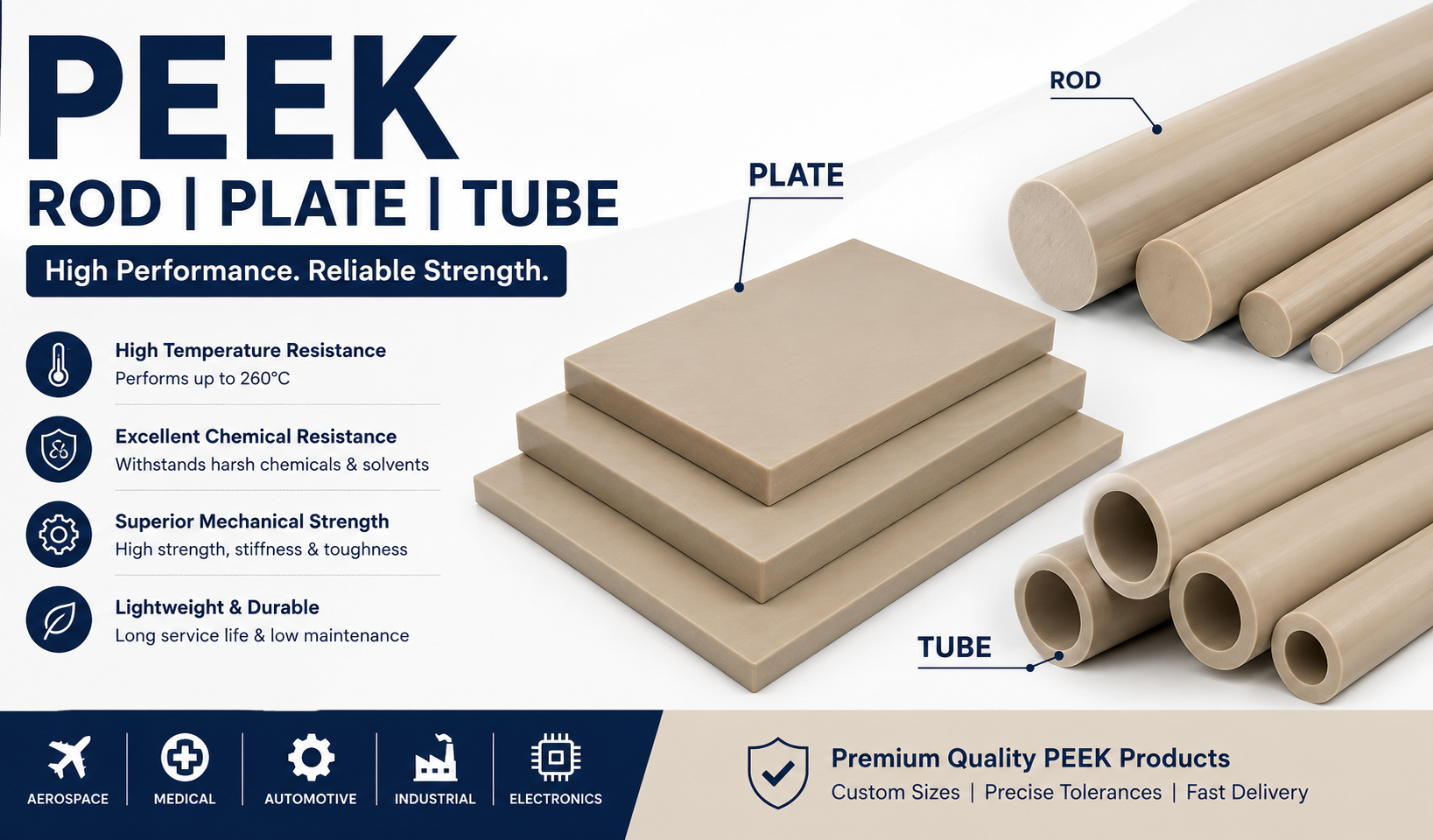
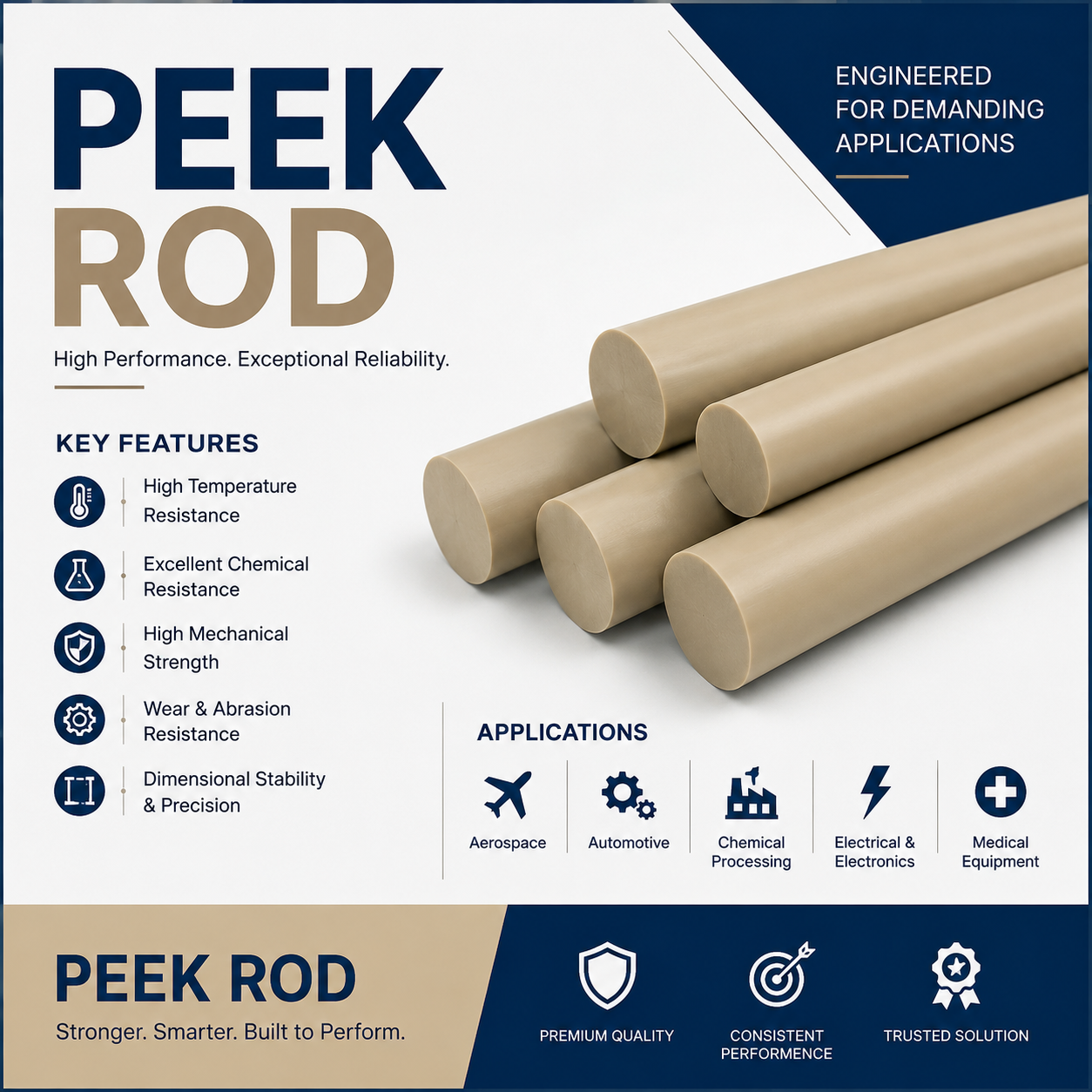
PEEK rod is a solid round engineering plastic made from Polyether Ether Ketone, a premium thermoplastic known for its outstanding mechanical and thermal properties. It belongs to the PAEK family of polymers and is widely used for manufacturing precision industrial components through CNC machining.
Unlike conventional plastics, PEEK maintains its structural integrity even in challenging environments involving high temperatures, chemical exposure, and continuous mechanical stress. This unique combination of properties makes it suitable for applications where metals are too heavy or prone to corrosion.
Many peek rod manufacturers in India produce PEEK rods in various diameters and grades to meet the needs of automotive, aerospace, pharmaceutical, semiconductor, and oil & gas industries.
Why Industries in India Prefer PEEK Rod
Indian manufacturing has become increasingly focused on precision, automation, and long-term reliability. Modern production facilities require materials that reduce downtime while maintaining consistent performance.
PEEK rod has gained popularity because it delivers exceptional durability without adding unnecessary weight. It performs reliably in high-speed machinery, automated equipment, medical devices, and chemical processing systems. As industries adopt advanced manufacturing technologies, the demand for high-performance engineering plastics continues to grow.
Today, several peek rod manufacturers in Mumbai supply industrial-grade PEEK rods to businesses throughout India, supporting both standard and custom machining requirements.
PEEK vs Nylon: Which Material Performs Better?
Nylon is one of the most commonly used engineering plastics because it is affordable, lightweight, and easy to machine. It performs well in many general-purpose industrial applications, including gears and bushings.
However, Nylon absorbs moisture from the surrounding environment. This moisture absorption causes dimensional changes that can reduce accuracy in precision components. In industries where tight tolerances are critical, even small dimensional variations can affect machine performance.
PEEK solves this problem by maintaining excellent dimensional stability regardless of humidity. It also offers significantly higher temperature resistance and greater mechanical strength, making it a better choice for demanding industrial environments.
For precision engineering applications, PEEK provides longer service life and more consistent performance than Nylon.
PEEK vs PTFE: Strength Makes the Difference
PTFE is widely recognized for its extremely low friction and outstanding chemical resistance. It is commonly used in seals, gaskets, and non-stick industrial applications.
Despite these advantages, PTFE has relatively low mechanical strength. Under continuous loads, it can deform over time through a phenomenon known as creep. This limits its use in structural or load-bearing components.
PEEK offers excellent chemical resistance while providing much greater stiffness and strength. Components made from PEEK can withstand higher mechanical loads without losing their shape, making the material suitable for bearings, valve seats, compressor parts, and precision wear components.
When both strength and chemical resistance are required, PEEK is often the superior solution.
PEEK vs Delrin: High Temperature Reliability
Delrin, also known as POM, is another popular engineering plastic valued for its excellent machinability and dimensional accuracy. It performs well in gears, rollers, and mechanical components operating under moderate temperatures.
The limitation of Delrin appears in heat-intensive environments. As temperatures increase, its mechanical properties gradually decline, reducing reliability in demanding applications.
PEEK maintains its strength and stiffness at temperatures that exceed the operating limits of Delrin. This makes it ideal for components used near engines, sterilization equipment, ovens, chemical reactors, and high-temperature manufacturing systems.
For industries requiring continuous performance under heat, PEEK provides a much larger operating window.
Exceptional Heat Resistance
One of the biggest reasons industries choose PEEK is its ability to perform in extreme temperatures.
PEEK can continuously operate at temperatures approaching 260°C while retaining much of its mechanical performance. In comparison, Nylon and Delrin generally perform best around 100–120°C, making them unsuitable for many high-temperature industrial processes.
This thermal stability allows manufacturers to use PEEK in aerospace components, automotive engine systems, semiconductor equipment, and industrial processing machinery where conventional plastics would soften or deform.
The result is improved reliability, fewer replacements, and reduced production downtime.
Outstanding Mechanical Strength
Industrial components frequently experience heavy loads, vibration, and repeated mechanical stress. Materials with insufficient strength often crack, deform, or wear prematurely.
PEEK combines high tensile strength with excellent stiffness, enabling it to perform reliably in structural applications. Its strength-to-weight ratio also makes it an attractive alternative to certain metal components where weight reduction is important.
Because of these characteristics, engineers frequently select PEEK for precision gears, bearing cages, bushings, rollers, and load-bearing machine parts.
Superior Chemical Resistance
Many industrial environments expose materials to oils, fuels, solvents, acids, alkalis, steam, and cleaning chemicals. A material that degrades chemically can lead to equipment failure and expensive maintenance.
PEEK offers excellent resistance to a broad range of industrial chemicals. This makes it particularly valuable in pharmaceutical manufacturing, food processing, chemical plants, and oil & gas applications where exposure to aggressive substances is common.
Its chemical stability helps extend component life while maintaining consistent mechanical performance throughout long production cycles.
Excellent Wear and Friction Performance
Wear resistance is essential for moving machine parts that operate continuously. Bearings, guides, gears, and sliding surfaces experience constant friction, making material selection critical for long-term reliability.
PEEK demonstrates outstanding tribological performance, meaning it performs exceptionally well under sliding and rotating conditions. It generates less wear than many conventional engineering plastics and maintains its properties even during prolonged operation.
This translates into reduced maintenance costs, longer replacement intervals, and improved overall machine efficiency.
Dimensional Stability for Precision Machining
Modern CNC machining demands materials capable of maintaining tight tolerances throughout manufacturing and operation.
PEEK offers extremely low moisture absorption and excellent dimensional stability, allowing machined components to retain their exact dimensions even under varying environmental conditions.
This makes it particularly suitable for robotics, automation systems, medical equipment, semiconductor manufacturing, and precision instrumentation where accuracy is essential.
Compared with Nylon and PTFE, PEEK provides greater confidence in applications requiring micron-level precision.
Common Industrial Applications of PEEK Rod
PEEK rod is used across numerous industries because of its versatility and high-performance characteristics.
In the automotive sector, it is commonly machined into thrust washers, transmission components, seals, and bearing elements. Aerospace manufacturers use PEEK for lightweight structural parts and electrical insulation components that must withstand elevated temperatures.
Pharmaceutical equipment manufacturers rely on PEEK because it tolerates repeated sterilization and chemical cleaning without degradation. Food processing machinery also benefits from its durability and resistance to harsh cleaning agents.
Oil and gas industries use PEEK for valve seats, compressor rings, seals, and wear components operating in aggressive environments. Semiconductor manufacturers choose it for precision insulating components used in highly controlled production systems.
These diverse applications demonstrate why demand continues growing among peek manufacturers throughout India.
Is PEEK Worth the Higher Price?
PEEK is more expensive than Nylon, PTFE, and Delrin, leading many buyers to question whether the investment is justified.
The answer lies in total lifecycle cost rather than initial purchase price. Although PEEK has a higher material cost, it often delivers significant savings through longer component life, reduced machine downtime, fewer maintenance interventions, lower replacement frequency, and improved production reliability.
For critical industrial applications where equipment failure is costly, PEEK frequently becomes the most economical long-term solution despite its premium price.
How to Choose the Right PEEK Rod
Selecting the correct PEEK rod requires evaluating the operating environment rather than simply choosing a diameter.
Engineers should consider maximum operating temperature, mechanical load, chemical exposure, friction requirements, machining tolerances, and whether an unfilled, glass-filled, or carbon-filled grade is most appropriate.
Working with experienced peek rod suppliers helps ensure the selected material matches the technical requirements of the application and delivers reliable long-term performance.
Finding Reliable PEEK Rod Manufacturers in India
Choosing the right supplier is just as important as choosing the right material. Reliable manufacturers provide consistent product quality, certified raw materials, technical documentation, multiple diameter options, CNC machining support, and dependable inventory for industrial production.
Several peek rod manufacturers in Mumbai have established strong reputations for supplying high-quality engineering plastics across India. Businesses should prioritize quality, technical expertise, and material traceability over simply selecting the lowest-priced supplier.
A knowledgeable supplier can also recommend the appropriate PEEK grade based on operating conditions, improving both performance and cost efficiency.
Conclusion
PEEK rod has established itself as the leading engineering plastic for demanding industrial applications because it successfully combines high-temperature resistance, exceptional strength, excellent chemical resistance, superior wear performance, and remarkable dimensional stability.
While Nylon, PTFE, and Delrin remain valuable materials for many general engineering applications, PEEK consistently delivers better reliability in environments involving heat, heavy loads, aggressive chemicals, and precision machining.
For manufacturers seeking long-lasting machine components and reduced maintenance costs, partnering with trusted peek rod manufacturers in India is a smart investment that supports productivity, equipment reliability, and long-term operational efficiency.
Frequently Asked Questions (FAQs)
1. Why is PEEK rod preferred over Nylon?
PEEK offers higher heat resistance, better dimensional stability, lower moisture absorption, and superior mechanical strength, making it ideal for precision industrial applications.
2. Is PEEK stronger than Delrin?
Yes. PEEK generally provides greater mechanical strength and performs reliably at much higher operating temperatures than Delrin.
3. Is PEEK better than PTFE for industrial parts?
PEEK is often better for load-bearing components because it combines excellent chemical resistance with much higher stiffness and wear resistance than PTFE.
4. What industries use PEEK rods in India?
Automotive, aerospace, pharmaceutical, semiconductor, food processing, robotics, oil & gas, and precision engineering industries commonly use PEEK rods.
5. Can PEEK rod be CNC machined?
Yes. PEEK is one of the best engineering plastics for CNC machining and is widely used for manufacturing precision industrial components.
6. What temperature can PEEK withstand?
PEEK can continuously operate at temperatures up to approximately 260°C, making it suitable for high-temperature industrial environments.
7. Does PEEK absorb moisture like Nylon?
No. PEEK has extremely low moisture absorption, allowing it to maintain dimensional accuracy even in humid conditions.
8. Why is PEEK more expensive than other engineering plastics?
Its advanced polymer structure, exceptional performance, specialized manufacturing process, and long service life contribute to its higher cost.
9. How do I choose the right PEEK rod supplier?
Look for suppliers that provide certified materials, technical support, multiple grades, machining capabilities, and consistent product availability.
10. Are PEEK rods available from manufacturers in Mumbai?
Yes. Many peek rod manufacturers in Mumbai supply industrial-grade PEEK rods in various sizes and grades to customers across India.