How to Choose the Right Exothermic Welding Mold for Earthing Applications

Ai Earthing
Electrical grounding systems play a vital role in protecting people, equipment, and infrastructure from electrical faults and lightning strikes. One of the most reliable methods for creating permanent electrical connections is exothermic welding. An Exothermic Welding Kit provides everything required to perform safe, durable, and highly conductive welds without relying on mechanical connectors.
Using premium exothermic welding material ensures that every connection delivers exceptional electrical conductivity, corrosion resistance, and long-term performance. Industries such as power transmission, telecommunications, oil & gas, renewable energy, railways, and commercial construction rely on exothermic welding because it creates molecular bonds that remain effective for decades.
This guide explains the components of an exothermic welding kit, its working principle, advantages, applications, installation process, and how to select the right supplier.
What Is an Exothermic Welding Kit?
An Exothermic Welding Kit is a complete set of tools and consumables used to permanently join copper conductors, grounding rods, and metal components through an exothermic chemical reaction.
Unlike conventional connectors, exothermic welding produces a molecular bond that becomes stronger than the conductors themselves. The resulting joint offers excellent conductivity and requires virtually no maintenance throughout its service life.
A complete kit enables technicians to perform accurate, repeatable, and safe welds across different grounding applications.
Components of an Exothermic Welding Kit
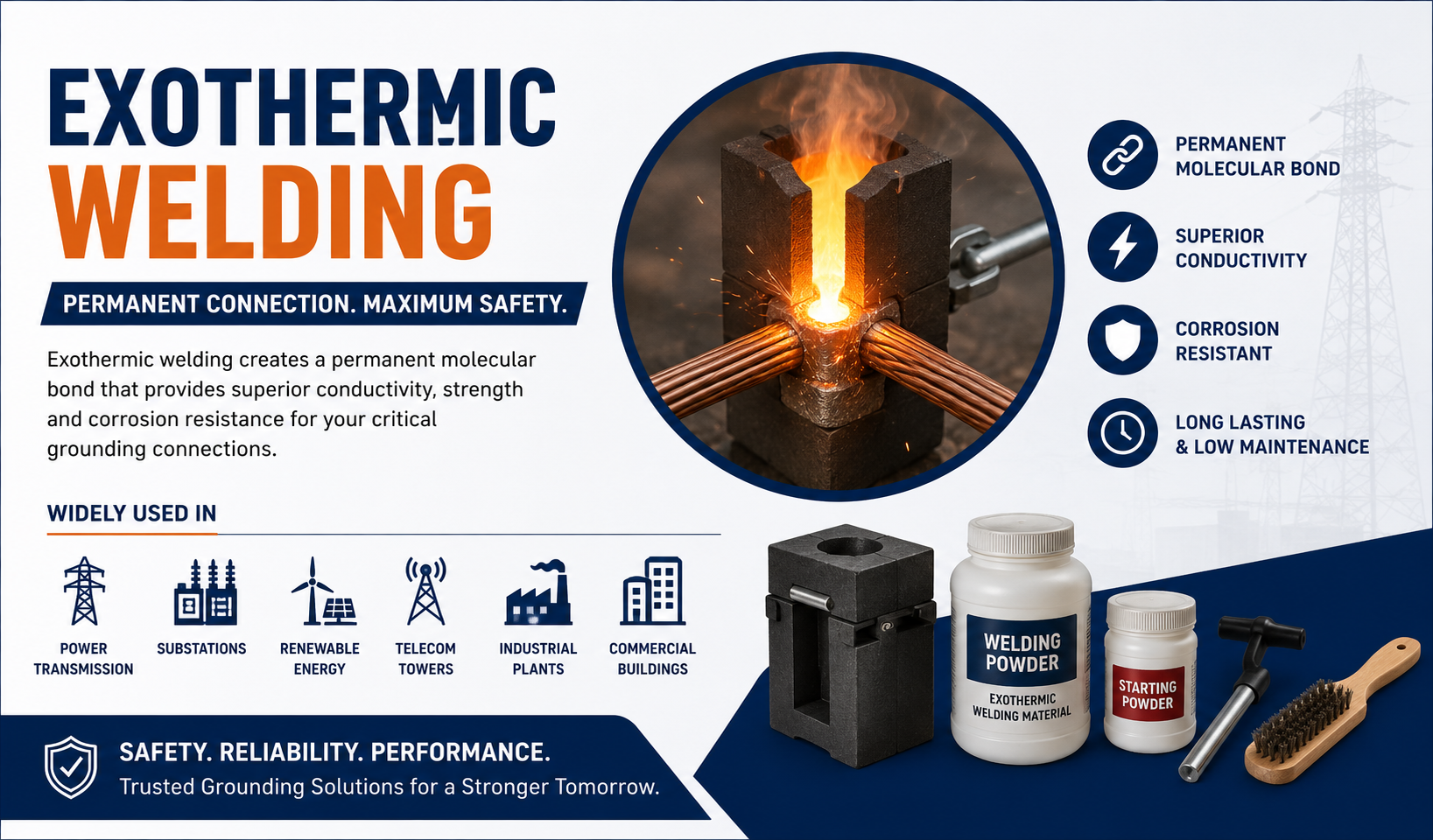
A professional exothermic welding kit generally includes:
- Graphite mold
- Mold handle clamp
- Exothermic welding material
- Starting powder
- Ignition flint gun
- Metal retaining disc
- Wire brush
- Mold cleaning accessories
- Protective gloves
- Safety goggles
- Storage box
Each component is designed to ensure consistent weld quality while maintaining operator safety.
What Is Exothermic Welding Material?
Exothermic welding material is a specially formulated metallic powder that undergoes a high-temperature chemical reaction when ignited.
The reaction generates molten copper that flows into the mold cavity, permanently joining the conductors.
High-quality welding material provides:
- Superior conductivity
- Uniform weld formation
- Minimal impurities
- Strong mechanical bonding
- Excellent corrosion resistance
- Reliable long-term performance
The quality of the welding material directly affects the strength and electrical performance of the finished connection.
How Does an Exothermic Welding Kit Work?
The welding process follows a straightforward sequence.
First, the conductors are cleaned thoroughly to remove dirt, grease, oxidation, and moisture.
Next, the conductors are placed correctly inside the graphite mold.
A metal retaining disc is positioned inside the mold before pouring the required quantity of exothermic welding material into the reaction chamber.
Starting powder is sprinkled over the welding material and around the lip of the mold.
The ignition flint gun ignites the starting powder, initiating a high-temperature chemical reaction.
Within seconds, molten copper flows into the mold cavity and fuses the conductors into a permanent connection.
After cooling for a short period, the mold is opened and the completed weld is inspected.
Benefits of Using an Exothermic Welding Kit
Permanent Electrical Connection
The weld becomes a molecular bond rather than a mechanical joint, eliminating issues associated with loose connectors.
Excellent Electrical Conductivity
The finished connection has very low electrical resistance, ensuring efficient fault current dissipation.
Superior Corrosion Resistance
Unlike bolted joints, welded connections resist corrosion even in aggressive environments.
High Mechanical Strength
The welded joint can withstand vibration, mechanical stress, and thermal expansion.
Maintenance-Free Performance
Once installed correctly, exothermic welds typically require no periodic tightening or maintenance.
Long Service Life
Properly executed welds often last as long as the grounding system itself.
Reliable Under Extreme Conditions
Exothermic welds continue to perform effectively under moisture, temperature fluctuations, and harsh weather.
Applications of Exothermic Welding Material
High-quality exothermic welding material is widely used in:
- Electrical substations
- Transmission towers
- Distribution networks
- Solar power plants
- Wind energy projects
- Railway electrification
- Telecommunications towers
- Oil and gas facilities
- Petrochemical plants
- Industrial manufacturing units
- Data centers
- Commercial buildings
- Residential grounding systems
- Lightning protection systems
These industries require permanent grounding connections that remain reliable throughout the life of the installation.
Types of Connections Supported
An Exothermic Welding Kit supports various conductor configurations, including:
- Cable to cable
- Cable to ground rod
- Cable to steel
- Cable to flat strip
- Cable to rebar
- Ground rod to flat strip
- Tee connection
- Cross connection
- Parallel connection
- Horizontal connection
- Vertical connection
Different graphite molds are available for each connection type.
Why Exothermic Welding Is Better Than Mechanical Connectors
Mechanical connectors rely on bolts, clamps, or compression fittings that may loosen over time due to vibration, corrosion, or temperature changes.
Exothermic welding creates a permanent molecular bond that offers:
- Lower electrical resistance
- Higher fault current capacity
- Better corrosion protection
- Greater mechanical strength
- No loosening over time
- Longer operational life
- Reduced maintenance costs
These advantages make exothermic welding the preferred choice for critical grounding systems.
Safety Tips While Using an Exothermic Welding Kit
Always follow recommended safety procedures.
- Wear protective gloves.
- Use safety goggles.
- Ensure the graphite mold is completely dry.
- Keep the work area free from moisture.
- Clean conductors before welding.
- Use the correct welding material size.
- Inspect molds for damage before use.
- Allow sufficient cooling time before opening the mold.
- Store welding material in a dry environment.
Following these practices helps ensure consistent weld quality and operator safety.
How to Choose the Right Exothermic Welding Material
Selecting the correct exothermic welding material depends on several factors.
Conductor Size
Choose welding material compatible with the conductor diameter.
Connection Type
Different connections require different material quantities and mold designs.
Industry Standards
Ensure products comply with recognized electrical grounding standards.
Material Purity
High-purity materials produce cleaner, stronger welds.
Manufacturer Experience
Choose an experienced manufacturer with proven quality control.
Technical Support
Reliable suppliers provide installation guidance and product recommendations.
Maintenance of Exothermic Welding Equipment
Proper maintenance extends the life of the kit.
- Clean graphite molds after every weld.
- Store molds carefully to prevent cracking.
- Replace worn handles when necessary.
- Keep ignition equipment clean.
- Protect welding material from moisture.
- Inspect molds regularly for wear.
Well-maintained equipment produces consistent welding results.
Why Choose AI Earthing for Exothermic Welding Solutions?
AI Earthing provides high-performance grounding products designed for demanding industrial applications.
Our advantages include:
- Premium quality exothermic welding material
- Complete Exothermic Welding Kit solutions
- Precision-engineered graphite molds
- Strict quality testing
- Reliable technical support
- Competitive pricing
- Fast delivery
- Custom grounding solutions
- Industry-compliant products
- Long-lasting performance
Our products help ensure safe, reliable, and maintenance-free electrical grounding systems.
Conclusion
A high-quality Exothermic Welding Kit is essential for creating permanent, low-resistance, and maintenance-free electrical grounding connections. When combined with premium exothermic welding material, it delivers exceptional conductivity, corrosion resistance, and mechanical strength that far exceeds conventional mechanical connectors.
Whether for substations, renewable energy projects, industrial facilities, or telecommunications infrastructure, exothermic welding remains the most trusted solution for long-lasting grounding performance. Choosing quality materials and following proper installation procedures ensures dependable electrical protection for decades.
Frequently Asked Questions (FAQs)
What is an Exothermic Welding Kit used for?
An Exothermic Welding Kit is used to create permanent electrical connections between copper conductors, ground rods, steel structures, and grounding systems using a high-temperature chemical reaction.
What is exothermic welding material?
Exothermic welding material is a specially formulated metallic powder that produces molten copper during an exothermic reaction to permanently bond conductors.
Is exothermic welding better than mechanical connectors?
Yes. Exothermic welding provides lower electrical resistance, greater mechanical strength, superior corrosion resistance, and a much longer service life than mechanical connectors.
Can exothermic welds corrode?
Properly executed exothermic welds have excellent corrosion resistance and typically last for the lifetime of the grounding system.
Where is an Exothermic Welding Kit commonly used?
It is widely used in substations, power plants, telecom towers, solar farms, wind energy projects, railways, oil & gas facilities, industrial plants, and lightning protection systems.
How long does an exothermic weld last?
A correctly installed exothermic weld can last for several decades and often remains effective for the entire lifespan of the grounding system.